
Happy Present Meet
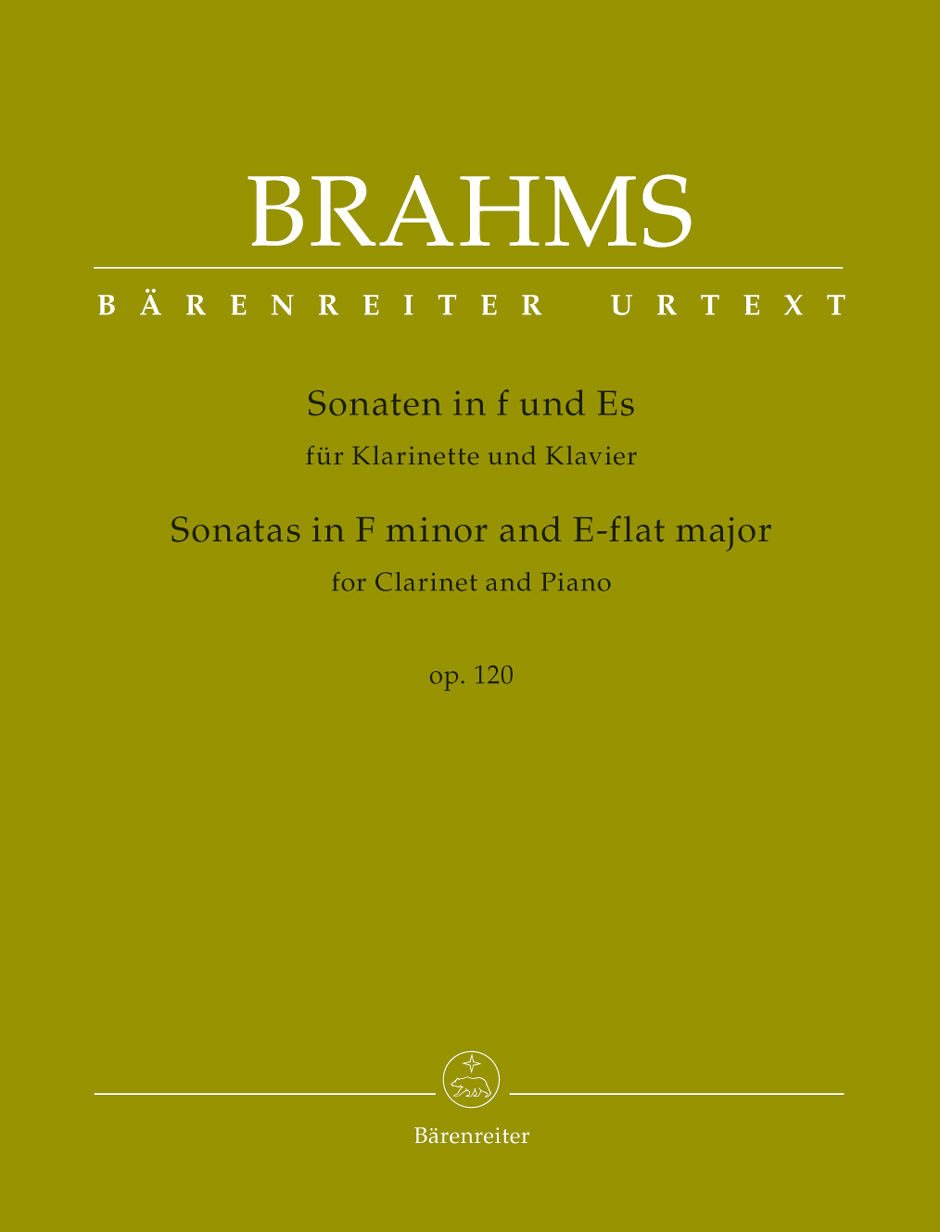
Brahms Sonatas in F minor and Eb major Op.120 for Clarinet and Piano
Brahms had already announced his retiremen from composition when in the spring of 1894 he played chamber music with the cellist Robert Hausmann and the clarinettist Richard Muhlfeld. This encounter apparently renewed his enthusiasm for Muhlfeld`s much admired playing and inspired him to write two clarinet sonatas in the summer of the same year. Brahms and Muhlfeld premiered the works and played them in several performances until the sonatas op. 120 were first published in June of 1895. They remain pivotal works in the clarinet`s recital repertoire establishing the clarinet sonata as a distinct and viable chamber music genre.
An important part of this edition is the extensive preface. Firstly it informs about the sonatas‘ origins, their compositional process, pre-publication performances, their publication history as well as early reception. Truly remarkable is the unique Performance Practice Commentary. Here the editors start from the premise that already a few decades after Brahms` death, a widening gulf developed between the composer1s expectations and the performance practices of the early 20th century. On the basis of manifold sources which include memoirs by pupils and chamber music partners, treatises and essays, early instructive editions and historical recordings, the editors deal with key issues in understanding Brahms` notation. By a section-by-section analysis of rhythm and timing, dynamics and accentuation, dots and strokes, slurring and non legato, piano pedalling and overholding, piano arpeggiation and dislocation, clarinet vibrato and portamento, the editors provide an indispensable assistance for a historically informed interpretation of the work. At the same time, the edition offers an exciting and often surprising insight into musical interpretation of the German Romantic Era in general.
- A pioneering Urtext edition
- With an extensive Performance Practice Commentary
- For further information on Romantic performance practice we recommend the text booklet: “Performance Practices in Johannes Brahms` Chamber Music”, BA 9600
Johannes Brahms:
The Works for one Instrument and Piano
Johannes Brahms’ compositions for one instrument and piano have been standards in chamber music literature ever since their inception. These works were written with specific performers in mind and Brahms worked closely with them when refining the final texts. Nevertheless, we rarely approach the music taking into consideration the possibilities of the instruments for which Brahms wrote or the performing practices of the individual players who first performed these compositions, including Brahms himself.
The New Urtext Editions
Bärenreiter’s pioneering new scholarly-critical editions of Brahms’ works for one instrument and piano are edited by a team of musicologists who are also performers. They offer today’s musicians not just a reliable musical text based on all known sources, but also a comprehensive approach to the works, which aims to place them in their historical context and to elucidate the complex of meanings that the composer wished his notation to convey to performers.
In addition to the musical text these editions offer an informative Introduction laying out the genesis, publication history and reception of the works. At the same time there is a complete list of the sources, an explanation of the editorial procedures and a Critical Commentary. Also, each volume contains a detailed discussion of specific performing practice issues raised by individual works.
An integral part of Bärenreiter’s Brahms publication complex is a text booklet which approaches general performance practice issues of the 19th century with regard to e.g. tempo, rubato, rhythmic flexibility and articulation. Furthermore musicians will find valuable information concerning vibrato, portamento and bowing. Last but not least characteristics of Brahms’ own piano playing as well as that of his circle and contemporaries are discussed.
The violin and viola sonata editions come not only with an Urtext part freed from all editorial emendations, but also with an additional part including fingering and bowing based on the practices of Joseph Joachim and his colleagues. These markings especially draw on publications of the sonatas edited by Joachim’s pupils Leopold Auer and Ossip Schnirlin as well as those by Brahms’ associate Franz Kneisel. A similar approach has been used for the violoncello sonatas, drawing on performance markings by Robert Hausmann (for whom Brahms wrote the Sonata in F major), Hugo Becker, with whom Brahms performed it, and Julius Klengel who was also close to his circle.
Bärenreiter’s new Brahms complex also importantly brings two neglected works back into the player’s hands, namely the splendid versions of the op. 120 sonatas, originally written for viola or clarinet and piano. Brahms’ arrangements for violin and piano unaccountably disappeared from the standard repertoire early in the 20th century. In these versions Brahms did not simply adjust the solo part for the violin, he made many alterations to the piano part, casting thought-provoking light on the clarinet and viola versions.
작곡가 Brahms, Johannes (1833-1897)
에디터 Brown, Clive
Costa, Neal Peres Da
Debussy Premiere Rhapsodie for Clarinet and Piano
Mendelssohn Variations Serieuses Op.54 for Piano Solo
[절판]Francaix Theme and Variations (Tema con Variazioni) for Clarinet and Piano
Debussy Premiere Rhapsodie and Petite Piece for Bb Clarinet and Piano
Francaix Concerto for Clarinet and Piano (Ed. Claude Francaix)
Sarasate Carmen Fantasy Op.25 for Clarinet and Piano (arr. Baldeyrou)
Uhl 48 Studies for Clarinet Solo (합본)
Clementi Selected Piano Sonatas Vol.2 (1790-1805) for Piano Solo
Clementi Selected Piano Sonatas Vol.1 (1768-1785) for Piano Solo