Happy Present Meet
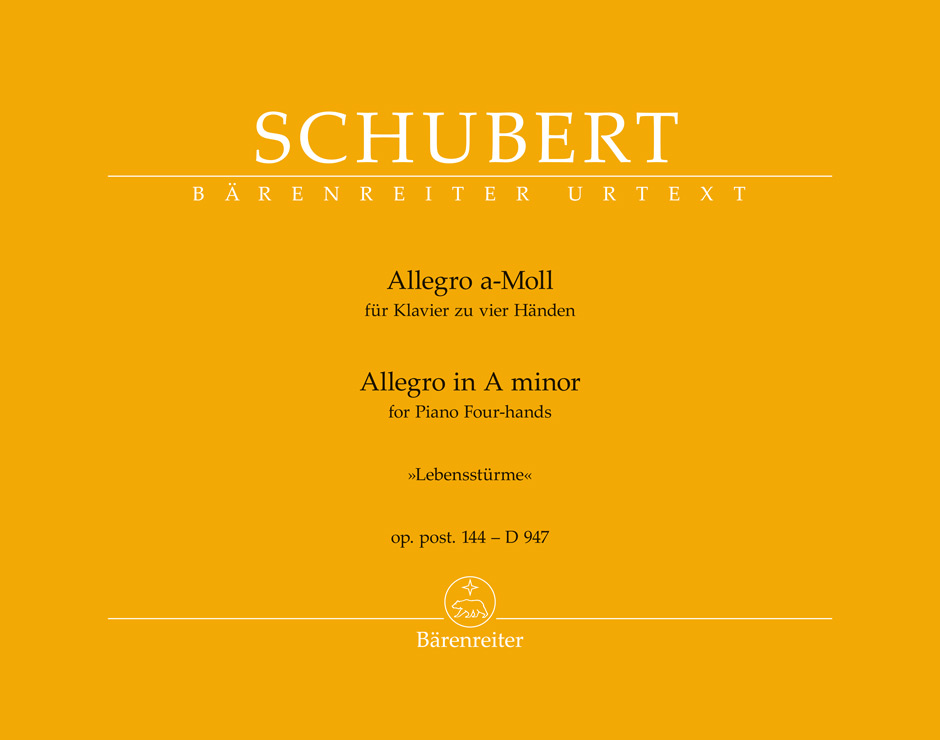
Schubert Allegro in A minor Op.post.144 D 947 "Lebensstürme" for Piano 4 Hands
(인생의 폭풍)
Comments on the edition: With notes on performance practice by Mario Aschauer
- Published on the basis of the “New Schubert Edition”
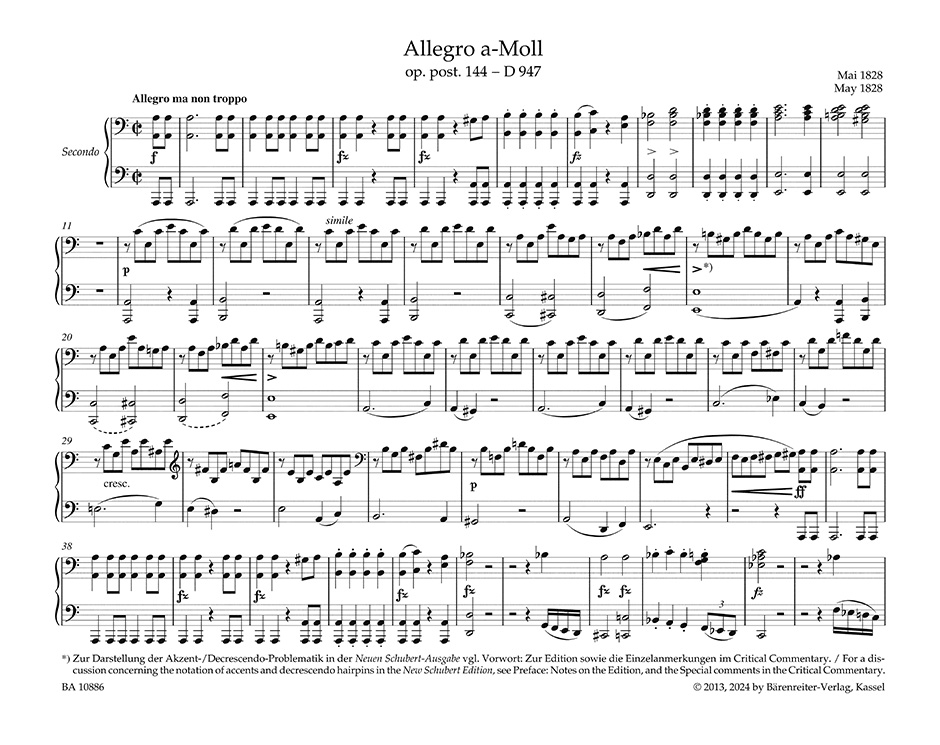
- In a reader-friendly landscape format with separate primo and secondo parts and practical page turns
- With informative notes on performance practice in Schubert's day (Ger/Eng), especially on Schubert's notation of accents, as well as interpretationally relevant readings in the Critical Commentary (Eng)
The Fantasia in F minor op. 103 - D 940 which was completed in April 1828, the last year of Schubert's life, was followed in May by the equally popular Allegro in A minor op. post. 144 - D 947 and in June by the Rondo in A major op. 107 - D 951. Schubert scholars assume that these works could have been movements of a third, unfinished sonata for four hands. Orchestral effects were a particular characteristic of Schubert's works for piano duet from the very beginning. It was most probably in the first edition published by Diabelli & Co. in 1840 that the Allegro in A minor was given the title “Lebensstürme” and the subtitle “Characteristisches Allegro”.
This Urtext edition is based on the definitive musical text of the “New Schubert Edition”. An informative Foreword and valuable notes on performance practice in Schubert's day (including articulation, use of pedal, ornamentation) with a special focus on Schubert's characteristic notation of > accents of different lengths provide an insightful introduction to the Allegro. The new edition is published in a reader-friendly landscape format with separate primo and secondo parts and practical page turns.
- "신 슈베르트 에디션"을 기반으로 출판
- 독자 친화적인 가로 형식에 프리모와 세컨도 파트가 분리되어 있으며, 페이지 넘김이 실용적입니다.
- 슈베르트 시대의 연주 관행에 대한 유익한 정보(독일어/영어), 특히 슈베르트의 악센트 표기법과 해석에 관련된 비평(영어) 자료 수록
슈베르트 생애 마지막 해인 1828년 4월에 완성된 F단조 환상곡 Op. 103 - D 940에 이어 5월에는 마찬가지로 인기 있었던 A단조 알레그로 Op. 144 - D 947이, 6월에는 A장조 론도 Op. 107 - D 951이 발표되었습니다. 슈베르트 학자들은 이 작품들이 네 손을 위한 미완성 소나타 3악장의 일부였을 것으로 추정합니다. 오케스트라 효과는 슈베르트의 피아노 이중주 작품에서 처음부터 두드러진 특징이었습니다. 1840년 디아벨리(Diabelli & Co.)에서 출판한 초판에서 가단조 알레그로에 "Lebensstürme(삶의 돌)"이라는 제목과 "Characteristisches Allegro(특징적 알레그로)"라는 부제가 붙었을 가능성이 높습니다.
이 원전판은 "신 슈베르트 판"의 최종 악보를 기반으로 합니다. 슈베르트 시대의 연주 관행(아티큘레이션, 페달 사용, 장식음 포함)에 대한 유익한 서문과 귀중한 주석은 슈베르트의 다양한 길이의 악센트 표기법에 특히 초점을 맞춰 알레그로에 대한 통찰력 있는 소개를 제공합니다. 신판은 독자 친화적인 가로 형식으로 출판되었으며, 별도의 프리모와 세컨도 파트, 그리고 실용적인 페이지 넘김 기능을 제공합니다.
작곡가 Schubert, Franz(1797-1828)
에디터 Litschauer, Walburga