
Happy Present Meet
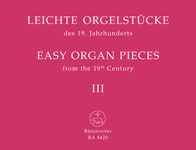
Easy Organ Pieces from the 19th Century Vol.3
1.
Vorwort
2.
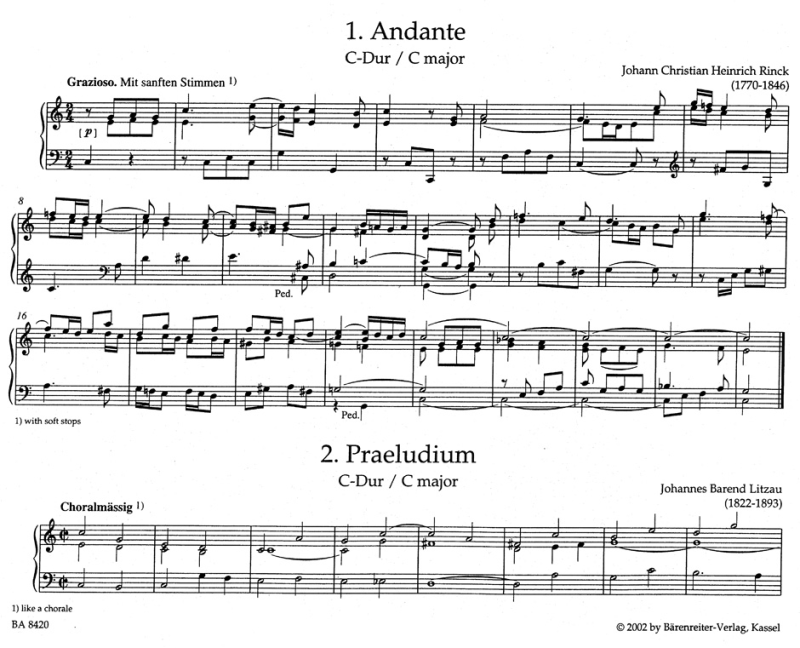
Johann Christian Heinrich Rinck: Andante
3.
Johannes Barend Litzau: Praeludium
4.
Michael Gotthardt Fischer: Piu Allegro
5.
Michael Gotthardt Fischer: Fuga
6.
Johann Christian Heinrich Rinck: Alla breve
7.
Johannes Barend Litzau: Praeludium
8.
Johann Beranek: Fuga a 4
9.
Carl Gottlieb Umbreit: Andante
10.
Michael Gotthardt Fischer: Fuge
11.
Conrad Greve: Fuga
12.
Michael Gotthardt Fischer: Fuge
13.
Johannes Barend Litzau: Praeludium
14.
Johann Christian Heinrich Rinck: Andante
15.
Gustav Merkel: Andante
16.
Johannes Barend Litzau: Praeludium
17.
Johann Christian Heinrich Rinck: Adagio
18.
Johann Christian Heinrich Rinck: Moderato
19.
Johann Ernst Rembt: Fughette
20.
Johann Christian Heinrich Rinck: Adagio
21.
Johann Georg Herzog: Praludium
22.
Gustav Merkel: Andante
23.
Johann Christian Heinrich Rinck: Andante
24.
Carl Gottlieb Umbreit: Commodo
25.
Johann Christian Heinrich Rinck: Larghetto
26.
Carl Gottlieb Umbreit: Andante
27.
Carl Gottlieb Umbreit: Grave
28.
Gustav Merkel: Allegretto
29.
Johann Beranek: Fuga a 4
30.
Carl Gottlieb Umbreit: Allegretto
31.
Johann Georg Herzog: Praludium
32.
Johann Christian Heinrich Rinck: Fughetta
33.
Johann Christian Heinrich Rinck: Adagio
34.
Johann Beranek: Fuga a 4 uber den Namen BACH
35.
Carl Gottlieb Umbreit: Sostenuto
36.
Michael Gotthardt Fischer: Fuge
37.
Gotthilf Wilhelm Korner: Fughette C-Dur fur vier Hande
38.
Quellen und Anmerkungen
Volume 3 in our series of easy nineteenth-century organ music provides semi-professional organists with another collection of short one or two manual organ pieces. The editor Martin Weyer , an organist regarded as an authority on nineteenth-century organ music, has limited his selection to works that combine solid craftsmanship with ease of performance.
In essence, volume 3 follows the editorial principles of its two predecessors while increasing the number of truly easy pieces. Among the composers represented is the Dutchman Johannes Barend Litzau (1822–1893), whose Preludes op. 13 and 17 are simple yet elegant works for beginners. The Czech composer Johann Beranek (1813–1885), on the other hand, was more concerned with counterpoint; his Ten Fugues appear here for the first time with detailed analyses to underscore the volume’s “learned” slant. Carl Gottlieb Umbreit (1763–1829) and his colleague Michael Gotthard Fischer (1773–1829) stand at the borderline between a galant organ style derived from Kittel and the early romantic age. Another composer who took part in this subtle stylistic evolution was Johann Christian Heinrich Rinck .
The brevity of the compositions makes them perfectly suitable for use as preludes and postludes in church services of all denominations. The volume contains detailed comments on performance practice and a list of sources.
편곡자 Weyer.M
작곡가 Various
Choral Preludes for Ascension and Pentecost
Sunday Morning Organist Vol.1: Solos for Christmas
Zipoli Organ and Cembalo Works Vol.2 : Cembalo works
Pachelbel Selected Organ Works, Vol.10
Organ Music for Church Service Vol.1
[절판]Bach Complete Organ Works Vol.1 : Orgelbuchlein / Schubler-Chorale
Bach Complete Organ Works Vol.5 : Preludes, Toccatas, Fantasias I
[절판]Bach Complete Organ Works Vol.6 : Preludes, Toccatas, Fantasias and Fugues II
Bach Complete Organ Works Vol.7 : Organ Trio Sonatas
Bach 8 Little Preludes and Fugues BWV 553-560 for Organ Solo